Are you planning a trip to Sweden this year and still wondering which travel option is the right one? Whether by ferry, via the Öresund Bridge through Denmark, by train, long-distance bus, or plane. Every option has its own advantages.
In this article, we provide an overview of the most important ferry connections, traveling by car via the overland route, as well as train, bus, and flight options. This will make it easy for you to find out which way of traveling to Sweden best fits your travel plans, your budget, and your personal travel style.
Note: Links marked with an * are affiliate links. If you purchase something through this link, we receive a small commission. The price remains the same for you.
In this article
Anreise nach Schweden: Deine Optionen im Überblick
| Travel options | Best suited for | Advantage | Disadvantage |
| Fähre | Travelers with campers, motorhomes, cars, etc. | Saves kilometers & fuel Overnight ferry allows for a relaxed start to your Sweden vacation | Early booking is important, otherwise it may be expensive |
| Overland route via Denmark(Self-drive) | Travelers with campers, motorhomes, cars, etc. | Flexible Stopover in Copenhagen possible | Long travel time and additional kilometers Bridges expensive depending on the vehicle category |
| Night train | If sustainability is important to you | Environmentally friendly, time-saving through overnight travel | Limited connections Expensive depending on category (sleeper car) |
| Long-distance bus | If you are budget-conscious | Cheap | Very long travel time |
| Airplane | City travelers or for a short trip Fast access to Northern Sweden | Fast Can be inexpensive | Poorer CO₂ footprint |
Traveling to Sweden by ferry
Ferry connections from Germany to Sweden
Traveling to Sweden by ferry is particularly popular with travelers with campers, cars, or vans, and we have also used it several times to save ourselves the long drive through Denmark. Furthermore, a ferry journey offers more comfort than many hours at the wheel.
The most popular ferry connections from Germany to Sweden
| Route | Ferry line | Duration |
| Travemünde – Malmö | Finnlines | Approx. 9 hrs. (also overnight) |
| Travemünde – Trelleborg Rostock – Trelleborg | TT Lines | Approx. 7 – 9 hrs. |
| Rostock – Trelleborg | Stena Line connection* | Approx. 6 hrs. |
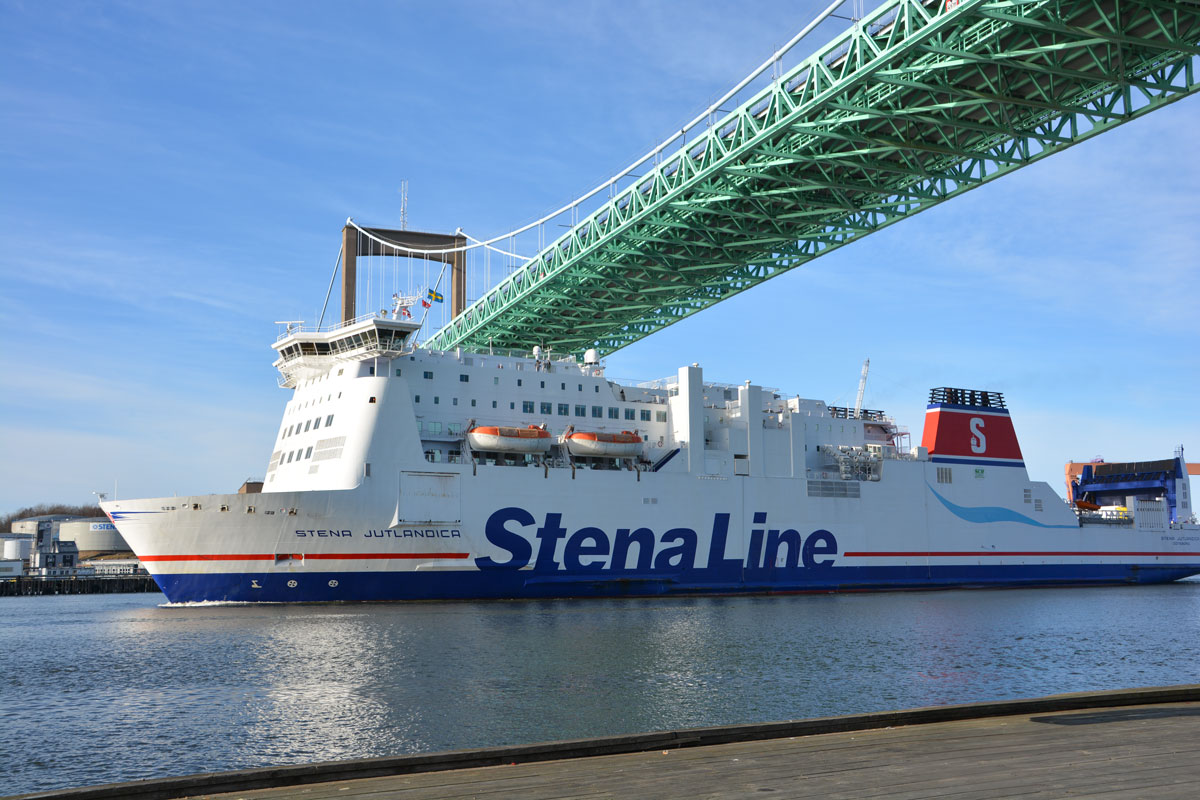
| Kiel – Göteborg | Stena Line connection* | Approx. 14.5 hrs. |
In our post "To Sweden by camper – with the Stena Line ferry from Kiel to Gothenburg," we report in detail on our personal experience with the crossing between Kiel and Gothenburg and provide tips on booking, prices, cabin options, and the entire process on board.
Ferry connections via Denmark
A ferry connection via Denmark is also worthwhile to avoid the long detour across the Danish mainland. The crossing is shorter and the ferries run several times a day.
The most popular ferry connections from Germany to Denmark
| Route | Ferry line | Duration |
| Puttgarden – Rødby | Scandilines | approx. 45 min |
| Rostock – Gedser | Scandilines | approx. 2 hours |
Continuing the journey to Sweden
If you travel with the Puttgarden – Rødby or Rostock – Gedser ferry, you can either enter Sweden via the Öresund Bridge or take the Helsingør – Helsingborg ferry (20 min).
Tips for booking the ferry
If you are flexible with your timing, it is worth comparing the different ferry operators and travel days, as price differences can be significant. For longer routes, overnight trips with a cabin are particularly comfortable, though usually more expensive.
By car to Sweden via the overland route
Traveling by land to Sweden takes you through Denmark. Across the Storebælt Bridge, you reach the island of Sjælland, where Copenhagen is also located. From there, you take the Öresund Bridge to Malmö in Sweden. This route is perfect if you also want to visit Copenhagen or if your destination is southern Sweden. Please note, however, that there are tolls for the bridges, which can be quite high depending on the vehicle category. Information on prices and payment can be found on the websites of the Storebælt Bridge and the Öresund Bridge.
| Vehicle category | Storebælt Bridge prices (as of February 2026) | Öresund Bridge prices (as of February 2026) |
| Car | 27€ -31€ | 56€ – 63€ |
| Vans and smaller motorhomes up to 10 m | 27€ -86€ | 112€ -125€ |
| Motorhomes over 10 m | 130€ -137€ | 198€ – 221€ |
Train and bus connections from Germany to Sweden
By night train to Stockholm and Gothenburg from Berlin or Hamburg
The train company Snälltåget offers night trains from Berlin and Hamburg to Stockholm. Some selected trains even start in Dresden. You can find the exact dates on which the train runs on the Snälltåget website.
Since spring 2026, there have been night train connections to Gothenburg from Berlin and Hamburg on some weekends. The connections are currently offered until mid-June. You can find the exact weekends on the website of the Swedish railway company SJ.
| Connection | Railway company | Duration |
| Berlin – Stockholm | Snälltåget | approx. 16 hours |
| Hamburg – Stockholm | Snälltåget | approx. 13 hours |
| Berlin – Gothenburg | SJ | approx. 13.5 hours |
| Hamburg – Gothenburg | SJ | approx. 9 hours |
The prices for night trains to Sweden vary greatly, depending on whether you book a seat or a sleeping car. While basic seats can sometimes be found for under €100, a sleeping car can easily cost several hundred euros.
By long-distance bus to Sweden
Long-distance bus companies also offer connections to Sweden. Flixbus provides direct connections from Hamburg or Berlin, although you will be on the road for a few more hours by bus.
Typical connections with FlixBus
| Berlin – Stockholm (via Copenhagen, Malmö/Lund, Jönköping, Linköping, for example) | Flixbus | approx. 19 hours |
| Berlin – Gothenburg (via Copenhagen, Malmö/Lund, Helsingborg, Halmstad, for example) | Flixbus | Approx. 14.5 hrs. |
| Hamburg – Stockholm (via Copenhagen, Malmö/Lund, Jönköping, Linköping, for example) | Flixbus | approx. 16 hours |
| Hamburg – Gothenburg (via Copenhagen, Malmö, Helsingborg, Halmstad) | Flixbus | approx. 11 hours |
Flight connections to Sweden
From the German-speaking region, there are several direct flight connections to Sweden.
| Flights from Germany to Sweden | Flights from Switzerland to Sweden | Flights from Austria to Sweden | |
| Direct flights to Stockholm | Berlin, Dusseldorf, Frankfurt, Hamburg, Hanover, Karlsruhe, Cologne; Munich and Stuttgart | Geneva, Zurich | Salzburg, Vienna |
| Direct flights to Gothenburg | Berlin, Düsseldorf, Frankfurt, Munich | Zurich | Vienna |
Flights to Southern Sweden
In the summer, there are direct flights from Frankfurt to Kalmar. Alternatively, there are connections from various international airports to Copenhagen, from where you can easily continue your journey to Sweden in just about 20 minutes across the Öresund Bridge by bus, train, or rental car.
Flights to Northern Sweden
The most important airports in Northern Sweden are Luleå and Kiruna. While SAS and Norwegian serve both airports year-round, there are recurring special flights during the winter months from cities such as Düsseldorf or Zurich. In addition, Arvidsjaur Airport in Swedish Lapland is served by several airlines, with flights available from Munich, Hanover, Stuttgart, or Cologne, for example.
Conclusion – How to find the right way to travel to Sweden
Whether by ferry, car, night train, or plane, the best choice depends on how much time you have, whether you are traveling with your own vehicle, and how much importance you place on sustainability.
- Do you want to get to the North quickly? Then a flight is the fastest way to travel.
- Are you traveling in your own vehicle, want to save on mileage, and arrive relaxed? Then the ferry is a great option. Especially with overnight ferries, you will arrive in Sweden feeling refreshed the next morning.
- Are you planning a road trip through southern Sweden? The land route via Denmark or the ferry to Denmark are good options and offer you the opportunity to visit Copenhagen. This is also a good option if you want to go to Oskarshamn to travel by ferry to the island from there Gotland onwards.
- Are you only planning a short trip and have limited time? A flight is usually the most efficient solution, but the night train can also be a relaxed option for traveling from Germany to Stockholm or Gothenburg.
- Is sustainability important to you? Then the night train to Sweden from Berlin or Hamburg is a great option.
- Are you on a tight budget? Then it is worth checking out long-distance bus prices, provided you don't mind the long journey.
Plan your trip as early as possible to save money on ferries, flights, or trains. If you're traveling with a camper or tent, feel free to check out our article on Wild camping and free camping in Sweden . There you’ll find some important information and tips.
FAQ – How to get to Sweden in 2026
Not necessarily. It is worth comparing the different providers. On the land route, you have to factor in additional fuel costs on the one hand, and on the other hand, there are costs for the Storebælt and Öresund bridges.
It is worth comparing the costs of the various ferry routes. If you are flexible regarding your route and travel days, the ferry can definitely be worth it. On the one hand, you save on fuel costs, and on the other hand, depending on the connection, the costs for the Storebælt and Öresund bridges are eliminated.
Yes, you can travel with your car or motorhome on the ferry to Sweden. StenaLine, Scandlines, and TT Line offer various connections from Germany to Sweden or to Denmark.
The costs for the Storebælt and Öresund bridges are based on the respective vehicle category. It is best to check the current prices for your vehicle on the websites of both bridges. You can also purchase your ticket directly there.
Yes, there are currently several night trains to Stockholm and Gothenburg. The trains to Gothenburg are currently only offered until mid-June. You can find the exact dates and prices on the websites of Snälltåget (Stockholm) and SJ (Gothenburg).
That depends on your departure station and your destination. From Hamburg to Gothenburg, it takes about 9 hours with the direct night train. From Berlin to Stockholm, it is 16 hours with a direct connection.
Direct flights are available from various cities. It's best to check comparison portals like Skyscanner for suitable flights.
A German identity card is sufficient for entry into Sweden. In addition, you should have health insurance and your vehicle documents (if you are traveling with your own vehicle) with you.