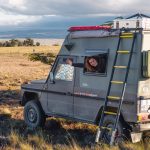
For 15 months, we traveled through South America in our small camper. Our vehicle, a Puch 230 GE from the Swiss Army, is robust and off-road capable, but above all, it is very small. With less than 4 m² of living space, our kitchen also had to be quite compact. Our minimalist camper kitchen (with the exception of the refrigerator and the drinking water tank) is housed in a drawer that we can pull out from the rear door. Despite the limited space, we had everything we needed for daily cooking. In the following, we share what we had in our small motorhome kitchen, what was useful, and what we could have left at home.
In this post, we will show you:
- our kitchen setup in the small camper
- which kitchen utensils proved their worth on our travels
- which utensils we bought as replacements or additions
- which utensils we bought as replacements or additions
Table of Content
Our Stoves – Cooking with Gas and Gasoline
Primus Tupike gas stove
The Primus Tupike* is a portable and powerful gas stove with two burners that can be used independently. It is our main stove. Since we unfortunately didn't have room for a gas tank, we had to cook with small gas cartridges, which is relatively expensive in the long run. The Primus Tupike is particularly suitable if you don't want a permanently installed stove in your camper. It is portable, and you can, for example, place it on the camping table to cook there. A big advantage for us was that it gave us the option to cook inside the camper during bad weather.
Advantages of the Primus Tupike at a Glance
- Two powerful, separately adjustable burners (3,000 watts each)
- Removable pot holders and drip tray make cleaning easier
- With integrated side windshields on both sides
- Adapters available for various gas connections
- Portable, allowing us to cook on the camping table or inside the camper during bad weather
Primus Omnilite TI Multi-fuel Stove
We had already been using the Primus Omnilite TI* on hiking and trekking trips before our South America journey. The Omnilite is a multi-fuel stove and can be used with kerosene, paraffin, gasoline, or diesel in addition to gas. In South America, it was a perfect addition to the Primus Tupike, allowing us to cook with gasoline, which is significantly cheaper than gas cartridges. We preferred using gasoline for dishes that required longer cooking times, such as bread, pizza, or quiches. Additionally, we could take the Primus Omnilite with us on our hikes. We used the fuel in a matching 1-liter fuel bottle* from Primus. Whenever available, we operated the stove with white gas. In South America, this is available as "Gasolina Blanca" in many hardware stores.
Advantages of the Primus Omnilite TI at a Glance
- High flexibility through the use of different fuels
- Weighs only 340g
- Perfectly suited as an additional stove and for hikes, trekking tours, or high-altitude mountaineering
Cooking with Gas or Gasoline – Advantages and Disadvantages at a Glance
| Petrol | Gas | |
| Availability | Available everywhere | Good, adapters necessary Different laws regarding gas refilling Cartridges not always available and expensive |
| Cost per cooking session | Günstig | Mit Kartuschen teuer |
| Leistung & Hitze | High heat, only coarsely adjustable | High heat, finely adjustable |
| Starting in cold/altitude | Good | Good with propane tank Performance decreases with butane cartridges (special winter gas cartridges available) |
| Usage | Complex, preheating required | Einfach, meist Piezo-Zündung |
| Cleanliness | Soot development, frequent cleaning is important | Clean combustion |
| Health & Safety | Soot and toxic fumes (not with white gas) Use outdoors only | Gas tanks belong in a ventilated gas locker Gas detectors are advisable |
| Odor | Strong odor development (no odor with white gas) | Odorless |
| Recommended for… | Long-term travel, overland tours, high altitudes Travelers who want to cook cost-effectively and don't want to worry about fuel availability | Weekend trips, simple cooking Travelers who have a large gas tank in their camper and/or value clean combustion |
If we had to decide today whether to cook with gas or gasoline/diesel, we would choose a gas stove once again. Operating a gas stove is cleaner and less complicated than using a gasoline stove. Furthermore, we were very impressed by the quality and robustness of the Primus Tupike, whereas we have heard rather mixed reports regarding the quality of large gasoline stoves, such as those from Coleman.
If no large gas tank is available, we would still bring along a small gasoline or multi-fuel stove to be able to cook and bake cost-effectively. While the Primus Omnilite TI is ideal for longer hikes and trekking tours where every gram counts, we would rather recommend the 450 g Primus Omnifuel* as an additional stove. This is also a multi-fuel stove that can be operated with gas, gasoline, diesel, petroleum, as well as kerosene. With 3000 watts of heat output, it is slightly more powerful than the Omnilite, which comes in at 2600 watts.
Refrigerator – The Dometic CoolFreeze CFX 28
Our Dometic CoolFreeze CFX 28 refrigerator is also indispensable. The 28-liter capacity is large enough for us to store groceries for several days. If we had more space, a freezer compartment would be a great addition, as it allows for even more flexibility and independence. We are very satisfied with our Dometic refrigerator*. We used it continuously every day for 15 months. Even at temperatures well over 30°C (86°F), it cooled reliably, was energy-efficient, and relatively quiet.
40-Liter Water Tank and Drinking Water Filter from RIVA
Our 40-liter water tank with a drinking water filter, which we installed in one of the side benches, is also indispensable. If you have more space, we recommend installing a larger tank to remain independent for longer periods. You will need clean water not only for drinking, but also for cooking and washing dishes, for example.
To purify the water, we installed the RIVA Alva Life and RIVA Alva Multi drinking water filters. Together, these filter out bacteria/legionella, pseudomonads, and germs, as well as heavy metals, chlorine, pharmaceutical residues, hormones, microplastics, and pesticides. With these two filters, we never had to worry about our drinking water quality. The water tastes excellent, and we experienced no issues with contamination.
More information about our camper water supply, our drinking water filters, and how to calculate your own water consumption and plan your own water supply can be found in our post Water supply in the camper – step-by-step to a fresh water system.
Cooking Utensils – What we needed
Omnia Oven for on the go
An absolute highlight was the Omnia oven*, which we used very frequently. Whether it was lasagna, quiche, bread, or cake, the Omnia played a huge role in making our cooking more versatile and flexible. Generally, almost anything you would typically prepare in a standard oven can be cooked or baked in the Omnia. Despite our limited space, we would definitely take the Omnia with us again anytime!
Pots, Plates, Cutlery, etc.
When it came to our cooking utensils, we tried to limit ourselves to the essentials and only brought enough for two people.
- 2 Pots and 1 Pan
- 1 Sea to Summit Kettle* for boiling water
- 2 Plates and 2 small bowls
- 1 large bowl for salad, dough, etc.
- 1 Strainer
- Cutlery for 2 people
- 2 cups
- 2 mugs
- 1 Bread knife (purchased later during the trip)
- 1 small sharp knife
- 1 cutting board
- Corkscrew / Bottle opener
- Tupperware containers for storing leftovers
- Cheese grater (purchased later during the trip)
- Scales (especially if you like to bake bread or cakes)
- Measuring cup
- Spatula
- Spätzle board
Coffee in the Camper – Our Setup
We are coffee lovers, and having a way to make good coffee in the camper is essential for us. During the trip, we swapped our Bialetti* for a Stanley French Press, which also doubles as a thermal mug. We boiled the water in our Sea to Summit kettle; this is significantly faster than using a pot and is therefore more energy-efficient. (Unfortunately, we could no longer find our specific Stanley French Press online.)
Why did we switch from the Bialetti to the French Press?
- We like the coffee from the French Press significantly better. From the Bialetti, it is very strong and often tastes burnt.
- The Stanley French Press also doubles as a thermos, making it ideal for driving days.
1 thermos bottle
Our thermos flask* sat untouched in our kitchen drawer for a long time, and we had already written it off as useless baggage. However, that changed when we reached the Andes, where we used it frequently for coca tea. On one hand, this is said to help with altitude sickness, and on the other, it meant we had hot tea for those cold evenings—because as soon as the sun goes down, it gets cold in the Andes. In the end, we were very glad to have it with us.
Clever Storage Solutions for Small Campers
Due to the limited space, we tried to find clever storage solutions to make the most of the small amount of room in our Puch.
Hanging storage on the door
We picked up a hanging organizer from IKEA and attached it to the inside of the rear door using Velcro. This is where we store items like our mugs and spatulas, as well as small things like lighters or pocket knives.
Fold-out table
We are very satisfied with our small fold-out table*, which we attached to the kitchen drawer. Without taking up much space itself, it provides us with an extra storage surface that we can use whether the drawer is extended or not. If you have or are planning a similar setup, we highly recommend such a fold-out table.
Washing basin as a cutlery drawer
In our small kitchen drawer, we installed a collapsible washing basin like the Collaps Wash Bowl from Outwell*. It is secured with small slats to the "ceiling" of the drawer. This allows us to store our cutlery while on the move and use it for washing the dishes after cooking.
Storage nets
We attached several storage nets* to the seating elements as well as the camper walls, as these provide space for smaller items like towels that would otherwise be flying around the camper.
What we would no longer take with us and what we purchased later
What we would leave at home
- Wine glasses: Wine glasses are certainly "nice to have" and surely a great addition for an extra dose of coziness and charm if you have more space, but they take up room. We disposed of them after just three days in South America.
- Cheese slicer: We also eventually got rid of our cheese slicer, as it just sat unused in the drawer. However, if you are traveling with your camper to Sweden, for example, a cheese slicer can be practical, as cheese there is not sold in slices but in larger blocks.
- Spätzle board: Our spätzle board was also certainly rather unnecessary on the trip. However, we did end up using it every now and then. Above all, it was a lovely way to have shared cooking evenings with other travelers we met along the way.
What we purchased later during the trip
- Bread knife: We baked a lot of bread in the Omnia along the way, so eventually we missed having a good bread knife and bought one.
- Cheese grater: While cheese can also be cut into small pieces to be spread over pasta or casseroles, it melts better when it is finely grated. That is why we picked up a small cheese grater.
- French Press: Da wir mit dem Kaffeegeschmack aus der Bialetti unzufrieden waren, haben wir uns unterwegs für eine French Press entschieden.
Things you should think about before building your kitchen
Before you start building your kitchen, you should ask yourself a few fundamental questions:
- Destinations & Regions: Europe, world trip, cold or hot climate zones, remote areas – this influences, for example, the decision on which energy source is the right one for cooking and how much fresh water you will need.
- Travel Type & Duration: Weekend trips, long-term travel, living full-time in the camper – this also influences the decision on how you want/can cook and how much water you need.
- Cooking Habits: Do you cook daily or rarely, simple dishes or elaborate ones, do you want to bake?
- Energy source for cooking: Gas, gasoline/multi-fuel, electric, or a combination – you can find a decision-making guide in our post: XXX
- Gas availability & adapters: Cartridges vs. bottles vs. gas tanks, refilling options, legal regulations
- Cooking in bad weather & cold: Indoor or outdoor kitchen, performance in sub-zero temperatures, susceptibility to wind
- Safety aspects: e.g., ventilation, storage of fuels, gas and CO detectors
- Space & Storage: Kitchen size, workspace, storage for pots and provisions
- Weight & Payload: Gas bottles, batteries, appliances
- Water Supply: Fresh water tank, waste water, hot water yes/no
- Power Supply: Battery capacity, solar, shore power, inverter – an overview of how to plan your solar power in the camper can be found in our post Solar System in the Camper: Step-by-Step to Your Own Solar Power Solution
- Backup Cooking Option: e.g., gasoline, gas, or electric stove as a reserve
Conclusion – Minimalist camper kitchen for small vehicles
Our 15-month journey through South America has shown: even with less than 4 m² of living space, a full-fledged, functional kitchen can be realized. With a compact gas stove as the main appliance, a multi-fuel or gasoline stove as a backup, a reliable refrigerator, and a clever storage solution, we were able to cook flexibly and efficiently, bake bread, and prepare coffee while on the road.
Flexibility is key, as we only truly understood what we actually needed after several weeks on the road. If necessary, you can always buy additional items while traveling or give away anything superfluous. We wish you lots of fun cooking and baking on your journey.
FAQ – Minimalist Camper Kitchen
Think about the following aspects in advance:
Destinations & Regions | Travel Type & Duration | Cooking Habits | Energy Source for Cooking | Gas Availability & Adapters | Cooking in Bad Weather & Cold | Safety Aspects | Space & Storage | Weight & Payload | Water Supply | Power Supply | Backup Cooking Options
Which appliances and utensils are necessary for a minimalist camper kitchen?
This is subjective. For us, a compact stove (gas or multi-fuel), refrigerator, pot and pan, dinnerware and cutlery, cutting board, knife, and possibly a small oven like the Omnia are essential. Everything should be lightweight, stackable, and multifunctional.
Which storage solutions are practical when space is limited?
Hanging organizers on doors, storage nets on walls or seats, foldable utensils such as washbasins and collapsible dishware, and fold-out tables as additional workspace.
How many liters of water should you plan for in a camper?
This is also very individual. For 2 people, 30–40 liters of fresh water is sufficient to be independent for several days. If you cook a lot, do laundry, or drive longer distances, you should plan for more. Drinking water filters ensure clean water while on the road. You can find more information on planning your water supply in our post. Water Supply in the Camper – Step-by-Step to a Fresh Water System.
Gas or Gasoline – which stove is better for the camper?
That depends heavily on where you are traveling and how long you will be on the road.
Gas: Easy to operate, clean, well-adjustable, ideal for short trips or campers with a gas tank.
Gasoline/Multi-fuel: Available everywhere, good for cold regions or long-term travel, somewhat more complex operation, dirty combustion.
Which stoves are suitable for travel in cold or remote regions?
Gasoline or multi-fuel stoves work reliably in cold conditions and at high altitudes. Gasoline is available almost everywhere. Gas availability can be more difficult depending on the country, and you will need suitable adapters for filling a gas tank. With propane gas, gas stoves also usually work reliably at high altitudes and in the cold. With cartridges, however, performance decreases. There is special winter gas that works better in the cold.
Do I need a backup stove?
Not necessarily, but a backup stove increases your flexibility. For example, those who cook with gas can use a small gasoline or electric stove as a reserve if cartridges are empty or unavailable.
How can I bake in a camper?
Large motorhomes often have a built-in oven. Those traveling in a small camper can replace a home oven with an Omnia oven. In this, you can prepare most dishes that would otherwise be cooked in a traditional oven.
How do I safely store gas or gasoline in the camper?
Gas cylinders and tanks should only be stored in ventilated cabinets. Gasoline/multi-fuel should be kept in sturdy, leak-proof bottles, such as a Primus fuel bottle, and should never be stored near heat sources.
Do I need a gas– and CO alarm in the camper?
If you mainly cook in the motorhome and have a gas cylinder stored, a gas detector definitely makes sense. It warns you of even the smallest amounts of propane/butane as well as the anesthetic gas ether. For this purpose, there are so-called 3-gas detectors. Additionally, a CO alarm may make sense to warn against carbon monoxide.